


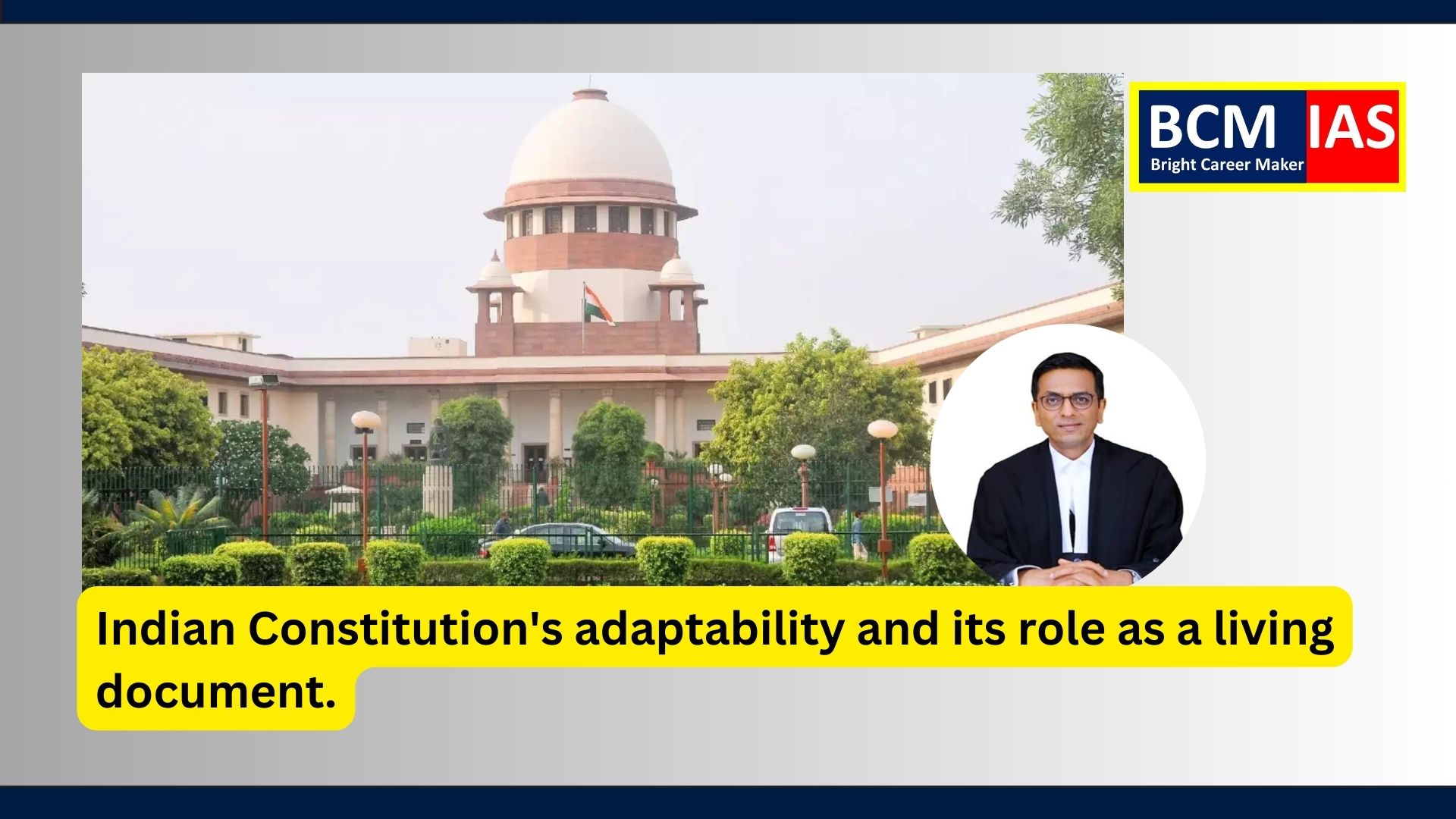
Indian Constitution's
adaptability
and its role as a "living document.
The news article highlights the speech delivered by Chief
Justice of India (CJI) D.Y. Chandrachud at the M.K. Nambyar Memorial
Lecture, where he emphasized the Indian Constitution's adaptability
and its role as a "living document." He stressed that constitutional
doctrine must evolve with society and that no generation, including the
present, can have a monopoly over interpreting solutions for future
challenges.
Key Points of Analysis:
1. Constitution
as a Living Document:
o CJI Chandrachud
emphasized that the Constitution evolves with time, society, and
emerging challenges. He indicated that the legal doctrine should adapt to the
changing needs of the times rather than being rigid or fixed. This idea of the
Constitution being a "living document" reflects the dynamic nature
of its interpretation.
o He rejected the
notion that any one generation, including the current one, can claim absolute
confidence in predicting future solutions or interpretations of the
Constitution.
2. Reference
to Key Constitutional Cases:
o The Chief
Justice referred to several landmark cases that shaped constitutional law. He
discussed M.K. Nambyar's contributions, particularly highlighting his
arguments in the A.K. Gopalan case, where Nambyar propounded the 'due
process of law' standard in Article 21.
o Kesavananda
Bharati case: He
also linked Nambyar’s work to the Basic Structure Doctrine, which was
established in the Kesavananda Bharati case. This doctrine continues to
serve as a safeguard against arbitrary amendments to the Constitution that
could alter its fundamental framework.
3. Supreme
Court’s Recent Electoral Bonds Decision:
o CJI Chandrachud
connected Nambyar’s arguments in the A.K. Gopalan case to the Supreme
Court's recent decision on electoral bonds, demonstrating how
fundamental principles that do not operate in isolation are interlinked across
time and legal contexts.
4. Nambyar's
Legacy and Approach:
o M.K. Nambyar was a senior advocate and
constitutional expert whose contributions significantly impacted Indian
jurisprudence. According to the CJI, Nambyar's legacy lies in his ability to go
beyond the "original intent of the framers" and interpret constitutional
provisions in a way that resonates with changing societal needs.
o Nambyar
showcased that constitutional interpretation should avoid a rigid allegiance to
the supposed intent of the framers and instead embrace a balanced approach
between completely abandoning and blindly following the framers’ vision.
5. CJI’s
Conclusion:
o Justice
Chandrachud
concluded that the Indian Constitution has thrived and maintained
relevance due to its ability to function as a living document. This
evolution and adaptability ensure its continued effectiveness in addressing
contemporary and future challenges.
Explanation:
The Chief Justice’s remarks emphasize the importance of constitutional
flexibility and judicial interpretation in safeguarding democracy
and responding to evolving societal contexts. By referencing landmark cases and
Nambyar’s contributions, he underscored the need for constitutional doctrines
that remain adaptive rather than static. This perspective reinforces the
idea that the judiciary’s role is not only to interpret the Constitution
according to historical intentions but also to ensure it meets modern and
future needs. This view also strengthens the dynamic interplay between
legal principles and societal transformation, ensuring the continued relevance
of the Constitution in a changing world.


Comments on “Indian Constitution's adaptability and its role as a "living document.”